Le facteur de chute
Le facteur de chute, détermine l'intensité du choc lors d'une chute réceptionnée dans un harnais.
Il faut tenir compte du facteur de chute, c'est à dire du rapport entre la hauteur de la chute et la longueur de la corde (ou de la longe) sur laquelle la choc va se produire :
Hauteur de chute / Longueur de corde.
Ce rapport détermine l'intensité du choc.
La force choc : De plus, le facteur de chute va s’appliquer sur des supports qui ont des capacités d'absorber plus ou moins les chocs, ce qui se caractérise par la force choc. (la force choc est l'énergie restituée lors d'un choc selon un facteur de chute donné. par ex, force choc en facteur 1, en facteur 2 et en facteur 0,3.
Attention : Si certaines cordes absorbent mieux les chocs (cordes d'escalade EN 892, ou cordages toronnés de petit diamètre), elles provoquent des rebondissements de l'antichute. D'autres augmentent le choc (par exemple des cordes en polypropilène, ou en kevlar, ou encore des sangles ou des câbles).
Même en cas de chute importante, par exemple de 2 mètres sur une longe (corde) de 10 mètres, le choc ne dépassera pas 450 daN ( pour une masse de 100kg) si on utilise une corde conforme à la norme EN 1891 type A.
...Même avec un faible facteur de chute, on ne doit pas pour autant s'autoriser des chutes de grande hauteur !
Le seuil d'occurence des lésions lors d'une chute dans un harnais est voisin de 600 daN, c'est en tout cas la valeur prise en compte par les normes européennes.
Au dessus de l'ancrage, un absorbeur d’énergie est indispensable
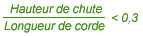
Facteur de chute inférieur à 0,3.
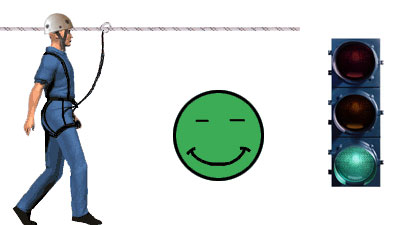
Au dessous de l'ancrage, le plus à l'aplomb est la situation la plus favorable lorsqu'on utilise un harnais.
Ce rapport ne doit pas dépasser "0,3" (un tiers) sur une corde EN 1891 type A.
(Exemple: 1 mètre sur 3 mètres de corde, 3 mètres sur 10, sinon le choc serait trop important.)
Facteur de chute égal à 1.
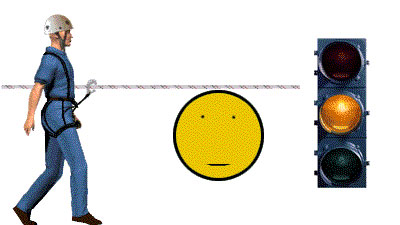
Au même niveau que l'ancrage, sans absorbeur le choc peut varier de 900 à 2000 daN, suivant le type de longe utilisée.
Pourquoi est-ce dangereux ?
- 1 - C'est dangereux parce que le choc peut être rude si on n'a pas un absorbeur. Dans ce cas le choc dépend du facteur de chute et de la force choc de la longe. Le choc peut aller de 900 à 2200 daN quelque soit la longueur de la longe. Nous sommes bien au delà du seuil d'occurence des lésions.
- 2 - C'est dangereux avec un absorbeur d'énergie en raison de la nécessité d'un grand espace libre en dessous de l'ancrage (de 4 m à 6 mètres suivant la longe utilisée).
- 3 - C'est dangereux car il faut pouvoir décrocher rapidement la personne suspendue.
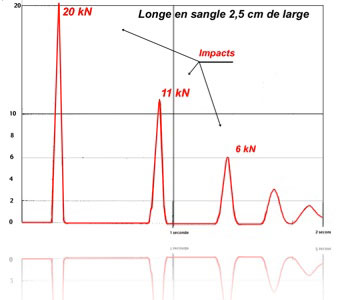
Ce graphique représente l'enregistrement de la réception d'une chute d'un poids de 100 kg sur une longe (EN 354) en facteur de chute 1 !
Le facteur de chute mesure l'intensité d'une chute. Plus il est élevé plus le choc sera rude. Il se calcule en rapportant la hauteur de la chute sur la longueur du support (Longe, corde, antichute...) Le facteur de chute minimum est donc de 0. Et si le point d'ancrage est fixe, le facteur de chute maximum sera de 2.
La force choc est la force qui sera restituée au moment du choc et transmise à la personne qui a chuté. Plus la longe (la corde, l'antichute) utilisée est élastique, plus elle absorbe de l'énergie, moins le choc sera violent.
L'ambiguïté de la législation : Art R4323-61 : "La protection des travailleurs doit être assurée au moyen d'un système d'arrêt de chute approprié ne permettant pas une chute libre de plus d'un mètre ou limitant dans les mêmes conditions les effets d'une chute de plus grande hauteur." C'est physiquement faux !!!
Facteur de chute égal à 2.
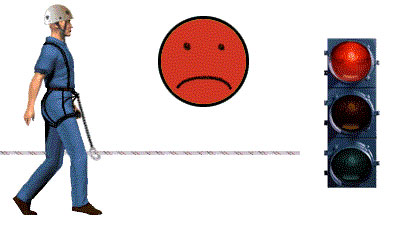
ETRE AU DESSUS DU POINT D'ANCRAGE C'EST DANGEREUX ! Facteur de chute 2 ou proche de 2. Absorbeur d'énergie OBLIGATOIRE !
Pourquoi est-ce dangereux?
- 1 - C'est dangereux parce que le choc peut être rude si on n'a pas un absorbeur. Dans ce cas le choc dépend du facteur de chute et de la force choc de la longe. Le choc peut aller de 900 à 2400 daN quelque soit la longueur de la longe. Les risques sont très élevés.
- 2 - C'est dangereux avec un absorbeur d'énergie en raison de la nécessité d'un grand espace libre en dessous de l'ancrage (de 4 m à 6 mètres suivant la longe utilisée).
- 3 - C'est dangereux car il faut pouvoir décrocher rapidement la personne suspendue.
Absorbeur d'énergie indispensable !
A NOTER : On peut faire une chute de 1 mètre avec une longe de 0,50 mètre si on est au-dessus de l'ancrage et recevoir un choc compris entre 25kN (sur une sangle par exemple) et 14 kN sur une corde toronnée.